
Entering Another World Through Character Sheets
When All Windows are Doors

This was first published in LFGcon Session 3 Player’s Guidebook
(Eds. Kevin, Habeeb, IsaacIsAfraid)
Players commonly use character sheets as control panels. It’s not wrong, that’s the intended use since the early days of mid-70s roleplaying. Like a crutch, they defer to their character sheet when they need to do something and unsure of what can they do within the game. They treat it as paper buttons.
But is that all character sheet can be? It’s true that a sheet is an interface to track game states and actions. Only, sometimes, they can be more. Character sheets can be a window into a strange new world. And like all windows, nothing is stopping us from treating them as doors.
What I mean is, for some character sheets, we can get a glimpse about the world that we are about to enter. Those paper interfaces can (and do!) facilitate our shared delusion at the table. Let me show you some of them.
Starting with this one from Cain by Tom Bloom:
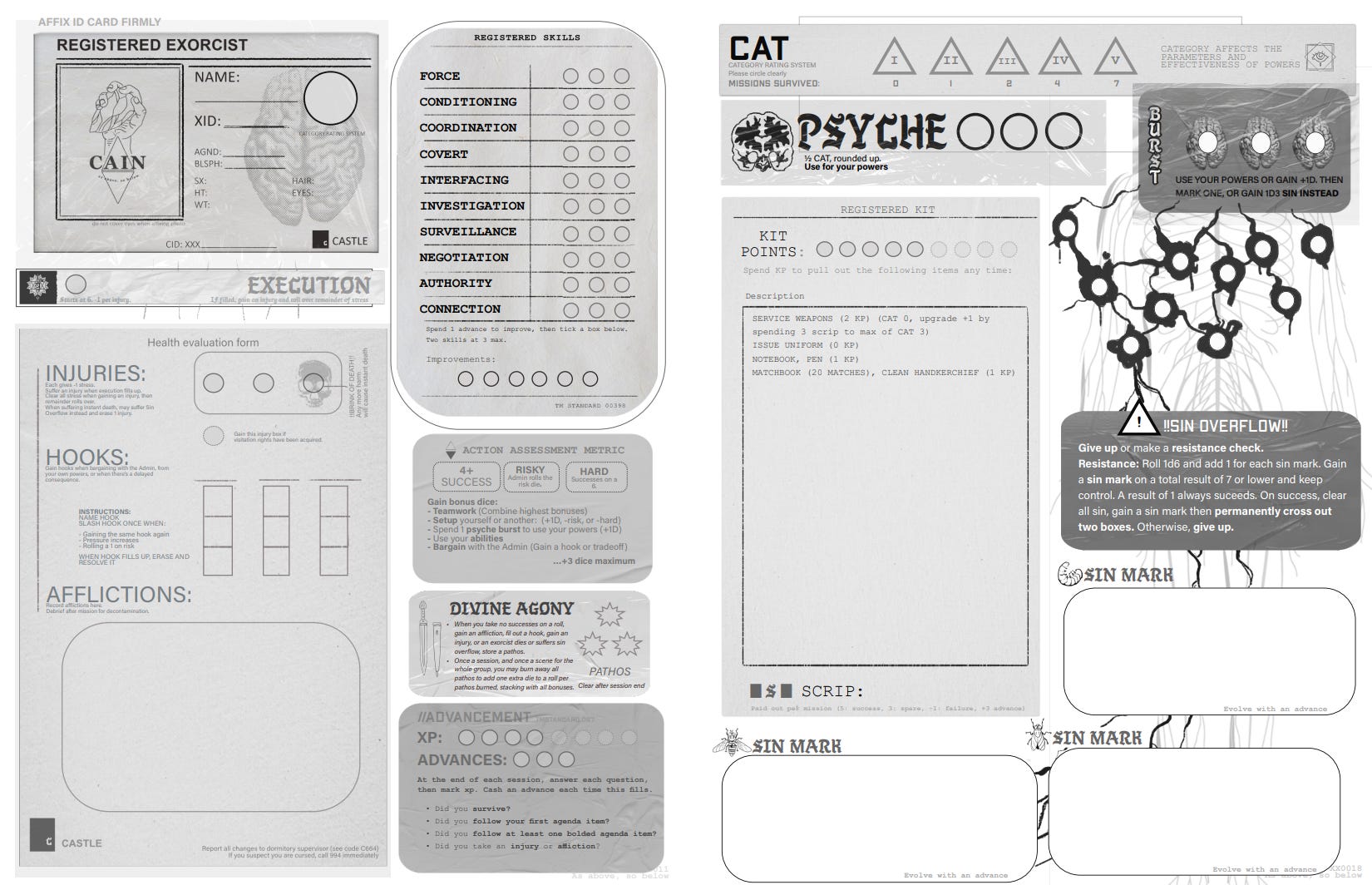
That character sheet instantly shows us the kind of world Cain operates in. It is a world of bureaucratic exorcism. It has rigid categorization of the supernatural. Our power as exorcists comes from either our own psyche or divinely inspired. Above all, this is a world of contemporary urban fantasy. Using this sheet during play allows you to dive right into the setting.
You see? That sheet is both a window and a door to the world of Cain. Of course the sheet’s stylish design helps in carrying the vibes. Not only from the information design and the UX side of things, but how the whole package is selling the fantasy.
Yes, that sheet can still be used as a crutch. It has paper buttons all over it. It’s full of trackers for various resources. But it’s also a door into an urban fantasy world. Two things can be true. Some are truer than others. In Cain’s case, the sheet truly evokes its setting. Using its sheet feels like you belong in that world.
Now let’s take a look of another sheet that’s more on the extreme side of style. Behold, the character sheet for Torq by Will Jobst:
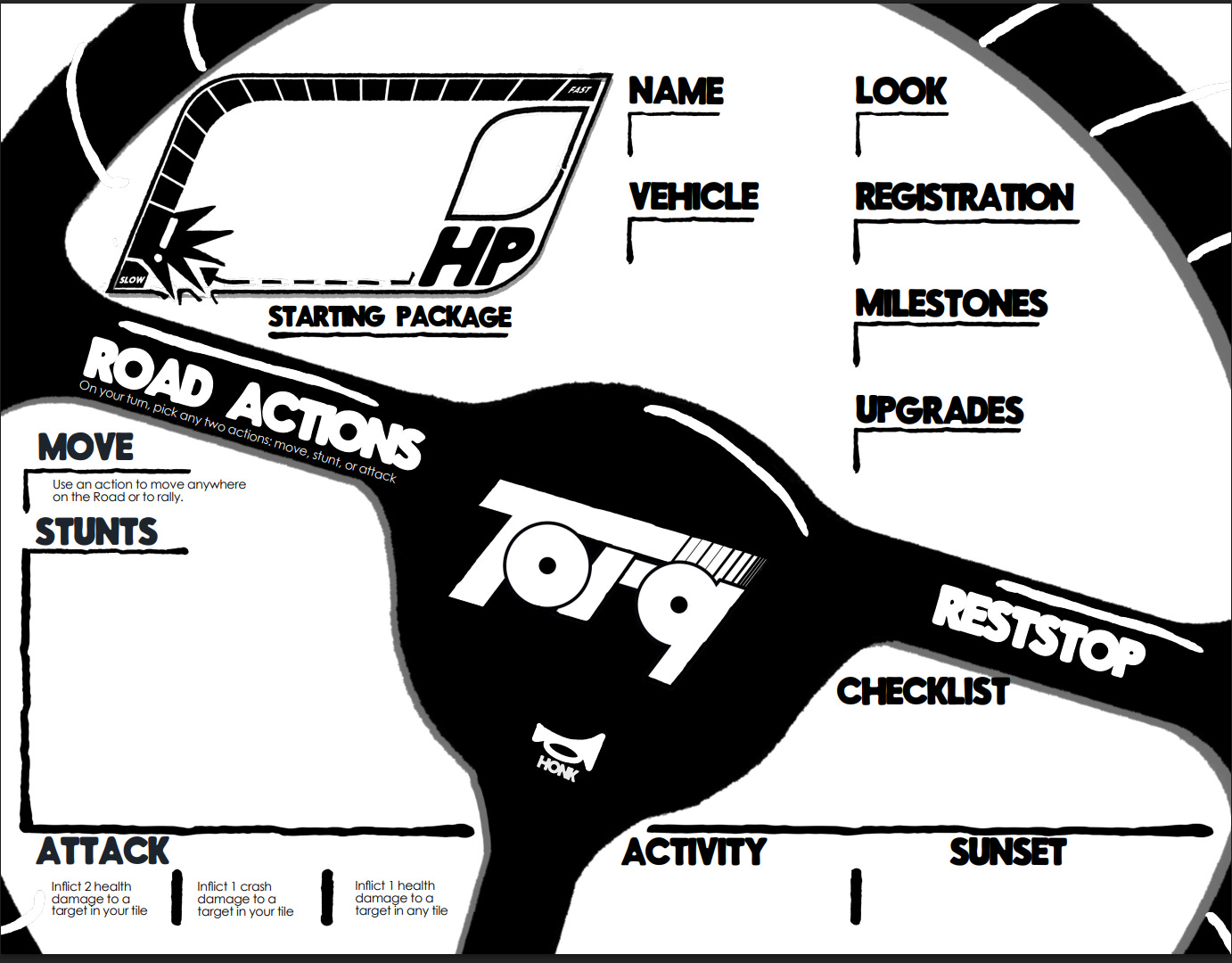
Quick, before learning anything about the game, what kind of game is this? The sheet is stylized as a steering wheel, there are two parts titled Road Actions and Reststop, we need to note our vehicle and registrations. There’s a honk icon on the steering wheel! Safe to say this is a game of driving cars.
So it’s a world about drivers doing stunts with their cars. It also has activities during rest stop, so there’s a freeform roleplay elements as downtime in-between car chases. Even without reading the book this sheet tells so much about the setting and system of Torq.
And don’t you just want to dive into it, seeing its whimsical steering-wheel sheet? Maybe turn it around during play, like a real wheel. Slam the honk when you need to. That sheet pulls a quadruple shift: acting as window, door, interface, and prop at the same time. Gotta admire the hustle.
Once again we see that a character sheet can be more than just paperwork. It is part of the game, after all. It’s as playable as miniatures and dice.
On the other end of the spectrum, we have the character sheet of Nobilis 2e by Jenna K. Moran:
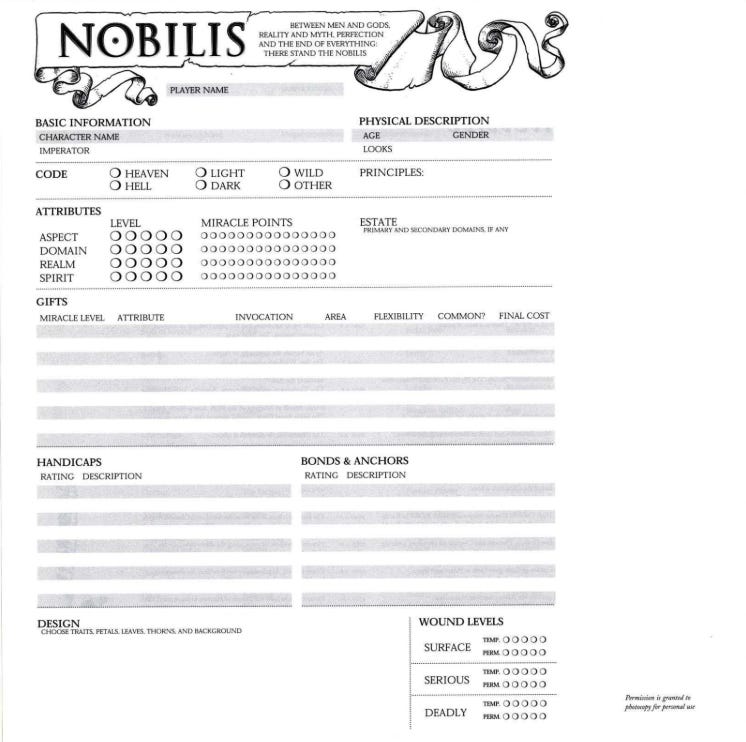
Instantly you know that this is a trad game. There are no stylish flairs like Cain or Torq except for the header. As a whole, it looks like we’re about to fill tax forms.
But look at the details. We have a Code, which can be assumed is some kind of alignment system. There are four attributes, each with their own miracle points (MP), yet the attribute names are strange: Domain? Realm? Wound Levels are familiar enough. Gifts must be some kind of spell list. Handicaps and Bonds & Anchors feel like for narrative flavor.
Even though this sheet is full of dry lists of things, they’re not what you usually find in other game’s character sheets. Every element in this sheet represents what’s important in the setting of Nobilis, not to mention the gameplay. Our Code lets us fill our MP by adhering to its principles. Gifts cost MP to activate. Handicaps grants us MP recovery when they interfere with our goals. We can lose MP if our enemies mess with our Bonds & Anchors. Nobilis, being a diceless game, revolves around MP economy, and it’s true in both the fictional world and the gameplay.
Like, you can plan an entire session just by looking at a character sheet. Threaten a Bond, prepare situations that highlight a Handicap, give choices that opposes a Code’s Principles. Not only is this sheet a door into the world, it’s also a door into what kind of future awaits in that world. It contains potential energy.
So. We’ve seen three instances of character sheets from different games. Three games from three cultures of play: neotrad, storygame, and trad. From the most stylish-looking to one that looks like filing taxes. They all do more than just passive interface despite coming from different cultures.
When you play or create a new game, I hope its character sheet helps you imagine the world that you’re about to enter. Look for ways where you can use it as a divination tool, a portal, or a truck that sends you to isekai. If you’re gonna share a delusion at a table, might as well have a baseline that anchors you together, right? A character sheet can be one such anchor.